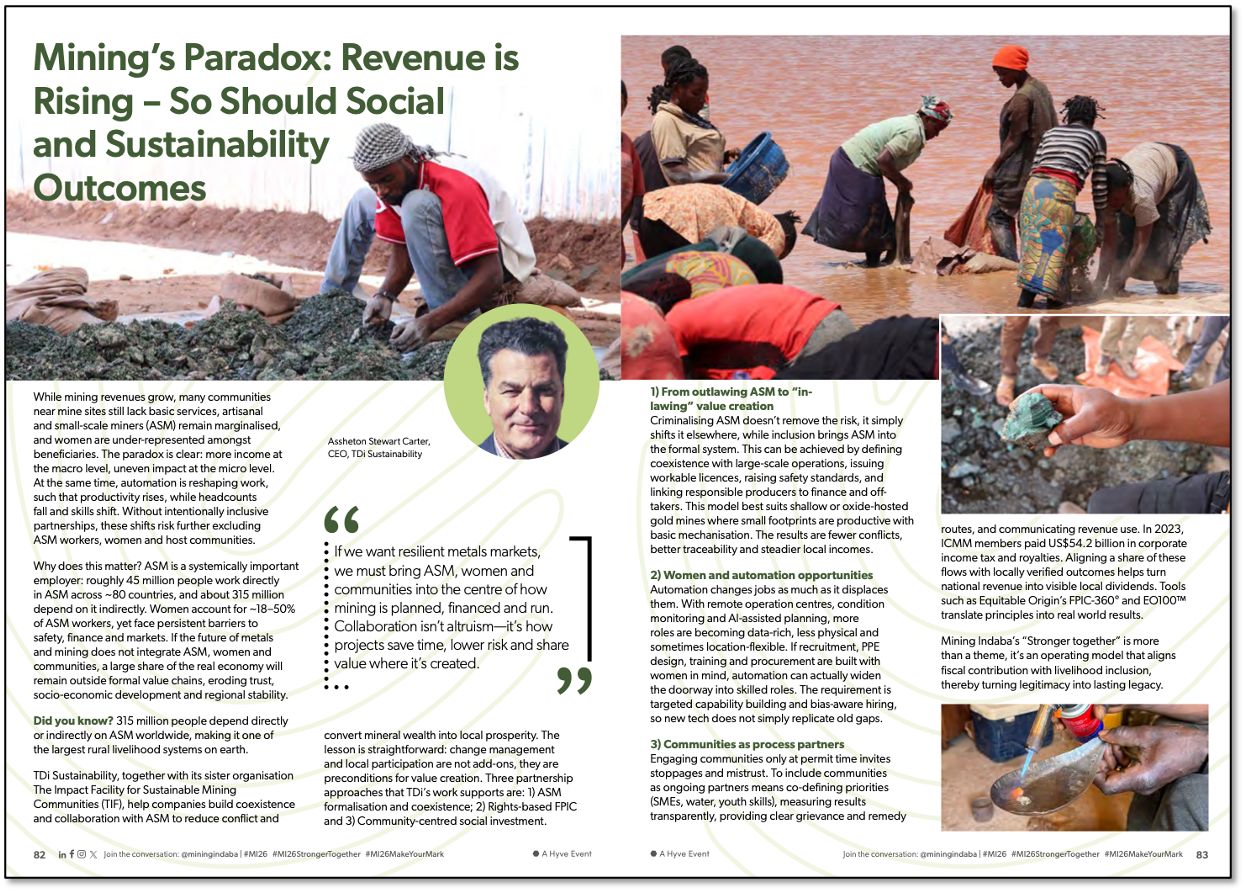
Mining’s Paradox: Revenue is rising – so should social and sustainability outcomes
December 22, 2025

At the same time, automation is reshaping work, such that productivity rises, while headcounts fall and skills shift. Without intentionally inclusive partnerships, these shifts risk further excluding ASM workers, women and host communities. Why does this matter? ASM is a systemically important employer: roughly 45 million people work directly in ASM across ~80 countries, and about 315 million depend on it indirectly. Women account for ~18–50% of ASM workers, yet face persistent barriers to safety, finance and markets. If the future of metals and mining does not integrate ASM, women and communities, a large share of the real economy will remain outside formal value chains, eroding trust, socio-economic development and regional stability.
This is an extract from Assheton Carter’s recent article for the Investing in African Mining Indaba Mining Pulse magazine (Issue 3 | December 2025 | Page 82) . Read the full article here