
Services – Risk Identification
Supply Chain Due Diligence
Other Risk Identification Services
What supply chain due diligence means in practice
Supply chain due diligence doesn’t mean a single audit, but an ongoing system. The OECD Due Diligence Guidance for Responsible Supply Chains – the framework most global regulation and industry standards now build on – sets out five steps, which when implemented properly becomes a continuous cycle – rather than a box ticking exercise once a year.
Find out about the Due Diligence Essentials series that TDi authored for the OECD.
The OECD five-step framework
- Establishing strong company management systems
- Identifying and assessing risk in the supply chain
- Designing and implementing a response to that risk
- Carrying out independent third party verification
- Reporting on due diligence performance
What TDi does
TDi Sustainability helps companies build and run t his cycle in practice.
- We map supply chains to identify where risk sits
- Develop supplier codes of conduct that set clear expectations
- Design corrective action plans when a supplier falls short
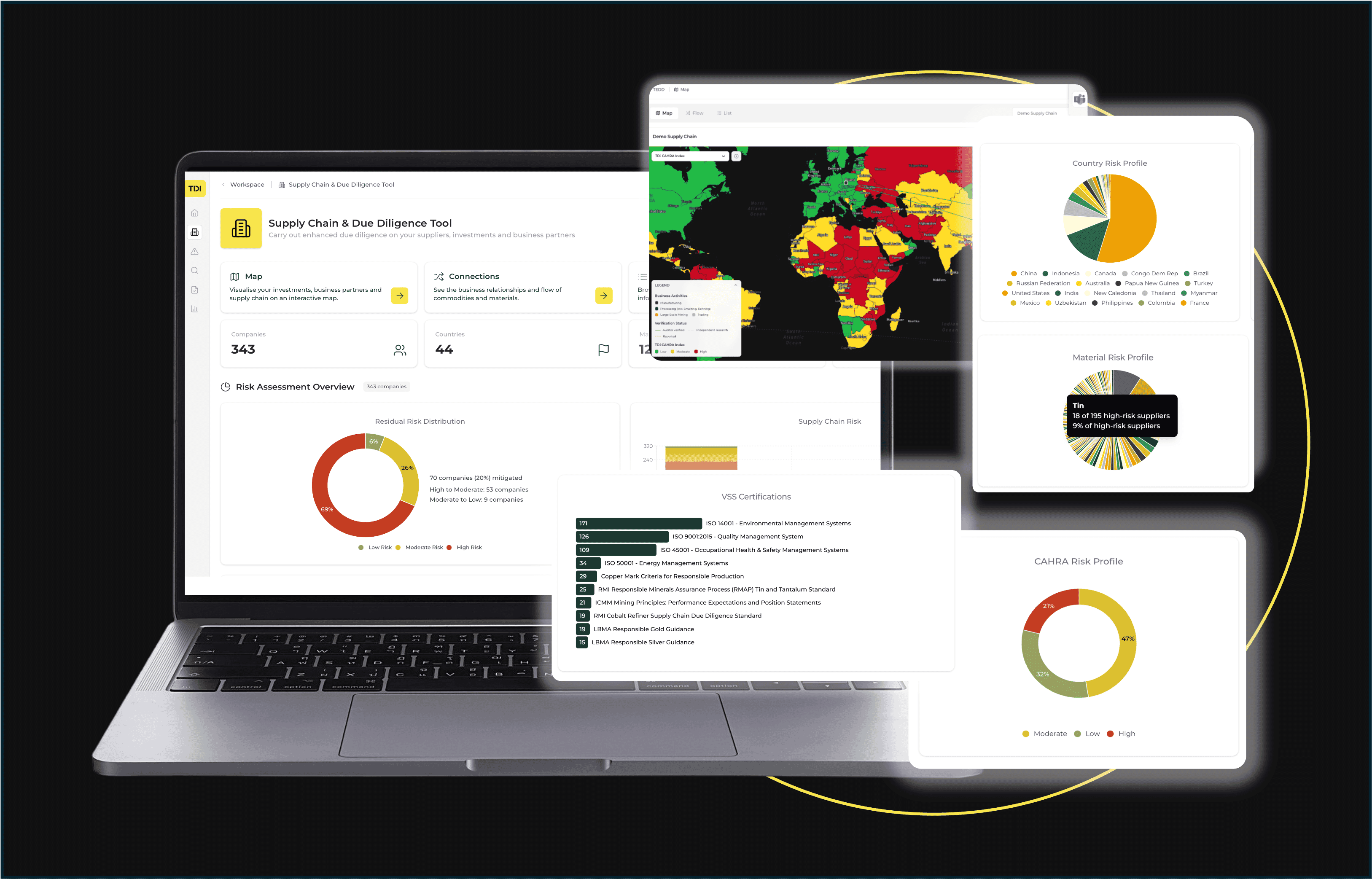
Our Supply Chain and Due Diligence Tool, part of the TDi Digital Platform, provides a digital backbone for this system. It scores suppliers for inherent and residual risk and flags when enhanced due diligence is needed – enabling the process to run continuously and automatically
Due diligence looks different by sector
This page is the general entry point to TDi’s due diligence services.
If your due diligence challenge is specific to critical minerals, visit our critical minerals due diligence hub for standards, credentials and sector-specific detail.
If your focus is mining more broadly, including community relations and social license to operate – visit our mining section.
Spot Market Due Diligence
Spot-market procurement differs fundamentally from long-term sourcing models and therefore require a distinct approach. In these transactions, the buyer typically procures already-produced material held by a trader, outside stable contractual arrangements with mining companies, processors or manufacturers. Conventional due diligence tools used in long-term sourcing models, such as supplier questionnaires, on-site assessments, audits or corrective action plans are often not applicable in this context. Although spot-market transactions present structural constraints, the EU Batteries Regulation still requires economic operators to apply risk-based due diligence.
TDi has developed a structured, practical and defensible decision methodology that enables the buyer to demonstrate adequate due diligence under conditions of:
- Limited leverage
- Incomplete information
- Time-sensitive purchasing conditions
- Transaction-level rather than relationship-level engagement
The underlying premise of this methodology is that compliance in spot-market settings must rely on proportionate measures and documented reasoning, rather than on full upstream verification.
Get in touch to find out how we can support your business with its spot market due diligence requirements.
Due Diligence Made Simple through the TDi Digital Platform
The Supply Chain and Due Diligence Tool
- Understand the ESG and supply risks associated with your mineral value chains
- Score your suppliers for inherent and residual risk, depending on how structural risks have been mitigated (i.e. through third-party certification)
- Determine when to conduct enhanced due diligence (i.e. on-site audit, desktop research, supplier questionnaire) depending on pre-defined risk thresholds.
- Assess the ESG and due diligence performance of your suppliers and counterparts through audits, and monitor continuous improvement through corrective action plans
- View your supply chain linkages and suppliers’ location, either as a geographic map or in flow-chart format
- Rate your supply chain visibility level, based on the accuracy and completeness of sourcing information available
Due diligence
Case Studies

OECD Due Diligence Essentials Series




Human Rights Impact Assessment in Nicaragua
Frequently Asked Questions
Supply Chain Due Diligence
What is supply chain due diligence?
- Establishing strong company management systems
- Identifying and assessing risk in the supply chain
- Designing and implementing a response to that risk
- Carrying out independent third-party verification
- Reporting on due diligence performance.
Does TDi offer due diligence software as well as consultancy?
What is the OECD Due Diligence Guidance?
Is due diligence for critical minerals different rom general supply chain due diligence?
Latest Insights
Progress on your journey to business resilience. We can make sure your organisation and your supply chain stand up to scrutiny, today and in the future
Other services that may be of interest:
Your project
made possible