
Positive Legacies for Mine Closure and Post-Closure Transition | TDi Report for Mining 2030 now available
December 10, 2025
[Image credit: Eden Project – Pete Whitbread Abrutat]
Report now available
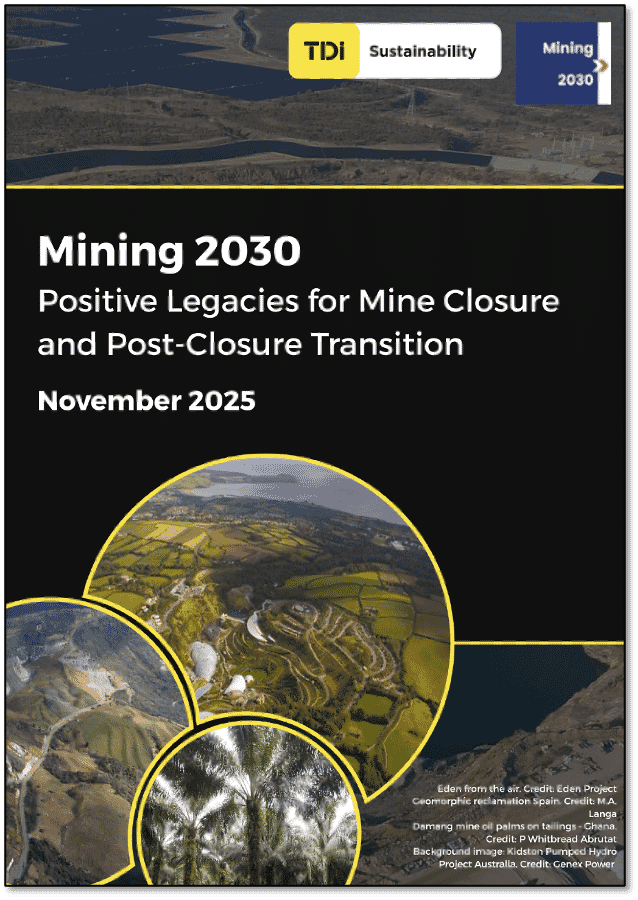
To arrive at a definition for positive mining legacy, the TDi team reviewed both literature and practice. The concept of is variously referred to as ‘closure’, ‘post-closure,’ and, more recently, “legacy”, reflecting changing understandings across the mining sector. The varied definitions that exist further reflect the complexity of the term “mining legacy,” shaped by differing legal responsibilities, sites’ status, and impact scopes. While institutional frameworks tend to prioritise environmental remediation and regulatory compliance, academic and civil society perspectives place greater emphasis on social dimensions, community well-being, and the need for inclusive and long-term remedial approaches. As environmental, regulatory and socioeconomic conditions evolve, so too does the nature and significance of mining legacies – making their recognition and management essential to just, future oriented transitions.
The definition developed by TDi considers multiple dimensions of mining legacy, including:
- Temporal aspects that extend beyond mine closure to consider enduring impacts;
- Spatial considerations that look beyond the mine site to communities, landscapes, and supply chains;
- Risk perspectives encompassing environmental, economic, social, human rights, and cultural aspects;
- Responsibility and governance frameworks for legacy management and transition.
The draft definition produced by the team underwent consultation in 2025 and the final report has now been published.
The TDi team would like to thank the Mining 2030 Secretariat, the Mining 2030 Working Group on Legacy chaired by Jill Cooper and Zak Wood, and Erin Parham, for their support in developing the report. We’d also like to thank all of the stakeholders who participated in the public consultation as well as Peter Whitbred-Abrutat for his case study contributions. This work is part of Mining 2030’s vision to enable a socially and environmentally responsible mining sector by 2030.
How TDi Helps the Mining Sector Build Positive Legacy
TDi has decades of experience supporting investors and companies in the mining sector to embed sustainability into the heart of their operations, from corporate-level strategy to asset-level due diligence and implementation with “boots on the ground”. Get in touch to find out how we can help.