Preparing for the EU Forced Labour Regulation: Implications for Mineral Supply Chains
June 11, 2026


The European Union (EU) Forced Labour Regulation (FLR) is moving from policy signal to commercial reality, and companies buying, trading, using minerals and metals should be paying close attention to the Regulation’s approaching implementation deadlines. The law will prohibit any products made with forced labour from being sold in the EU market – whether for European consumption or onward export.
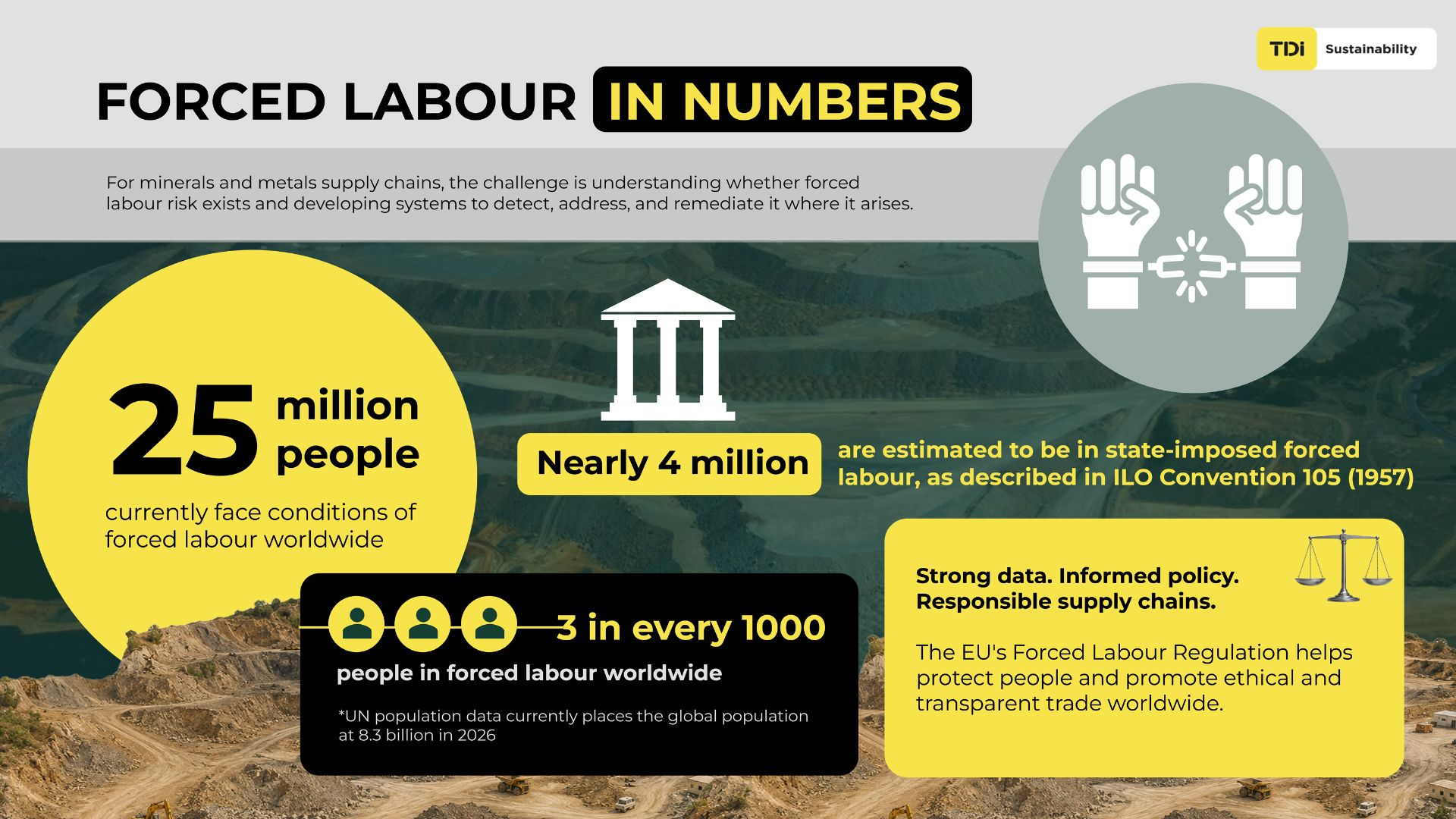
The International Forced Labour Convention, 1930 (no. 29) defines forced labour as “all work or service which is exacted from any person under the threat of a penalty and for which the said person has not offered himself voluntarily.” The definition applies whether labour occurs in the formal or informal economy, and across industries. The EU FLR responds to the serious risk of abuses in the modern global economy: estimates suggest that as many as 25 million people face conditions of forced labour currently around the world. Nearly 4 million of these individuals are estimated to be in conditions of state-imposed forced labour as described in International Labour Organisation Convention 105 (1957). The EU FLR is thus an important effort to ensure the European market does not benefit or enable these abuses.
EU FLR and the minerals/metals sector
For companies in minerals and metals supply chains and beyond, the FLR matters because it turns forced labour risk into a market-access issue. From 14 December 2027, products made wholly, or partly, with what is defined as forced labour, will be prohibited from being placed on the EU market, made available within it, or exported from the EU.
The Regulation applies across sectors and geographies, meaning that forced labour risks linked to extraction, processing, refining, trading, manufacturing or transport may all become relevant where they are connected to a product entering, or leaving, the EU market. In June 2026, the European Commission will publish a public database as a resource to understand forced labour risks in specific geographies and in relation to specific products, sharpening scrutiny on supply chains.
This is particularly significant for minerals and metals, because the highest-risk parts of the supply chain are often the least visible to downstream buyers. Risk may sit several tiers upstream in informal mining areas, labour recruitment practices, subcontracted workforces, processing facilities, or transport and logistics contractors. In some cases, risks arise in politically sensitive regions where coercive labour systems are alleged or documented.
For minerals and metals supply chains, the challenge is understanding whether forced labour risk exists and developing systems to detect, address, and remediate it where it arises. A forced labour policy is a starting point, but not sufficient to meet the FLR: the Regulation raises the bar for companies, expecting them to be able to produce credible evidence about the conditions under which materials were extracted, handled, processed and traded.
Minerals supply chains are especially exposed because they often stretch across multiple countries, layers of traders, and informal production systems. Artisanal and small-scale mining (ASM) is a major focus area for forced labour risk management in these supply chains. ASM is an important livelihood source for an estimate 45 million people worldwide, but it is also frequently associated with precarious working conditions, informality, and labour abuses, including various forms of forced labour. Illicit financial flows and co-option of ASM communities, expose workers to increased risks of forced labour, including with the implication of criminal or armed groups in some countries.
In ASM settings, forced labour and child labour may occur side by side. Because of the hazards to which mining exposes children, participation in ASM is typically classified as among the worst forms of child labour under ILO Convention 182. The convention recognises overlap between potential debt bondage and other severe poverty-related social risks, many of which are relevant upstream in informal ASM supply chains. These risks are particularly noteworthy across critical mineral supply chains, including aluminium, cobalt, copper, indium, lithium, manganese, nickel, silicon, 3T materials, and zinc.
It can be anticipated that goods known to be produced by ASM may well be scrutinised by the EU Member State Competent Authorities in the scope of the FLR, or appear on the forthcoming database from the Commission. Visibility over upstream supply chain phases will be important under the FLR, in order for EU importers to be confident in the conditions in which minerals are extracted, handled, and traded in order to reduce their exposure to forced labour risks.
How does the FLR work?
In our previous article, published in March, we looked in more detail at the scope of the Regulation, the enforcement powers available to competent authorities, how investigations are expected to work, and how companies ought to prepare. The core message for companies is that due diligence and risk analysis will need to go beyond direct supplier relationships. Buyer-side declarations, contractual clauses, or supplier self-certifications are unlikely to be sufficient where authorities, customers or civil society actors raise concerns about a product, geography, sector or supply chain.
Instead, companies should begin building a more granular evidence base. For minerals and metals supply chains, this may include site-level records of origin, chain-of-custody information, licensing status, production and transport records, and documentation showing how forced labour risks were identified, assessed, and mitigated. The purpose of these processes is to show that companies understand the upstream realities of their supply chains and have taken proportionate steps to manage forced labour risks before they crystallise into enforcement action.
The FLR differs from many other EU supply chain regulations. The FLR is broader compared to the EU Conflict Minerals Regulation, the Batteries Regulation and the Deforestation Regulation, which are each structured around particular commodities, product categories, or sectors. The Regulation also differs from the US Uyghur Forced Labor Prevention Act (UFLPA), which focuses on documented forced labour risks in the Xinjiang region of China. The UFLPA targets entities that mine, produce, or manufacture goods wholly or partly in Xinjiang, and prohibits these from entry into the United States unless the importer can meet a high evidentiary threshold. Certain mineral and metal supply chains are subject to in-depth scrutiny by the US Department of Labor due to links to Xinjian, such as aluminium, polysilicon mined from quartz, and nickel.
The EU FLR does not assume the same geographical restriction for forced labour risks and is instead agnostic of country or product. This approach is consistent with the EU’s previous due diligence regulations, mirroring, for example, how the EU Conflict Minerals Regulation looks at global tantalum, tin, tungsten, and gold imports into the EU, zooming out from the focus on the Great Lakes Region of Africa in the US Dodd Frank Act Section 1502.
However, there is one critical similarity between the UFLPA and the FLR that should not be understated, and that is enforcement. Like many of the EU’s other supply chain regulations, the FLR requires supply chain due diligence. In terms of functionality, however, the FLR does not place reporting obligations on importers. Instead, like the UFLPA, the implementation mechanisms will involve both risk-based assessments and investigation, and potential customs enforcement. This approach raises the enforcement bar and makes compliance with the FLR a market access priority, with competent authorities physically preventing goods associated with forced labour from entering a single market.
Looking Forward
Concern over forced labour is increasingly being deployed in geopolitical and trade competition, which makes the risk landscape more dynamic and less predictable. New forced Forced Labour Import Bans (FLIB) were announced by the US government just last week, placing new tariffs on trade partners Washington accuses of falling short of preventing goods produced with forced labour from entering the market in those countries.
At the same time, new credible risks of forced labour are unearthed regularly. Forced labour is a reality across a broad range of supply chains, from medical gloves to AI infrastructure, and frozen seafood to EV batteries. It is a risk in labour markets in Europe, the US, and many other countries. This shifting context makes accurate upstream knowledge even more important, because companies need enough visibility to respond as the goalposts move. In Europe, the Commission’s forthcoming implementation guidance and forced labour risk database will be central to shaping how the FLR works in practice.
Look out for an upcoming webinar to be hosted by TDi’s supply chain due diligence experts, on how to prepare for the FLR. Companies that invest in traceability, supplier engagement, stakeholder-informed risk assessment, remediation, and credible documentation will be better placed to respond to forced labour allegations, customer questions and regulatory investigations.
Get in touch to discuss how TDi can support your business.