
The EU Battery Regulation (EUBR) is here. Are e-bike and scooter OEMs ready?
October 1, 2026

The EU Battery Regulation (EUBR), Regulation (EU) 2023/1542, was published on July 28, 2023, to enforce a circular, sustainable lifecycle for all batteries entering the European market. It created sweeping requirements for EV supply chains, ranging from mandatory carbon footprint declarations to the implementation of Digital Battery Passports, effectively making responsible sourcing a legal obligation rather than a voluntary sustainability pledge.
However, while public scrutiny is largely focused on passenger cars, the electric two-wheeler market faces equally stringent rules. Depending on the weight of the vehicle battery, electric motorbikes and scooters fall under either the Light Means of Transport (LMT) category or the broader Electric Vehicle (EV) category. Ultimately, the compliance deadlines that apply depend on how the vehicle’s battery is classified, and on the role of the economic operator placing the product on the market.
The seven pillars of EUBR compliance
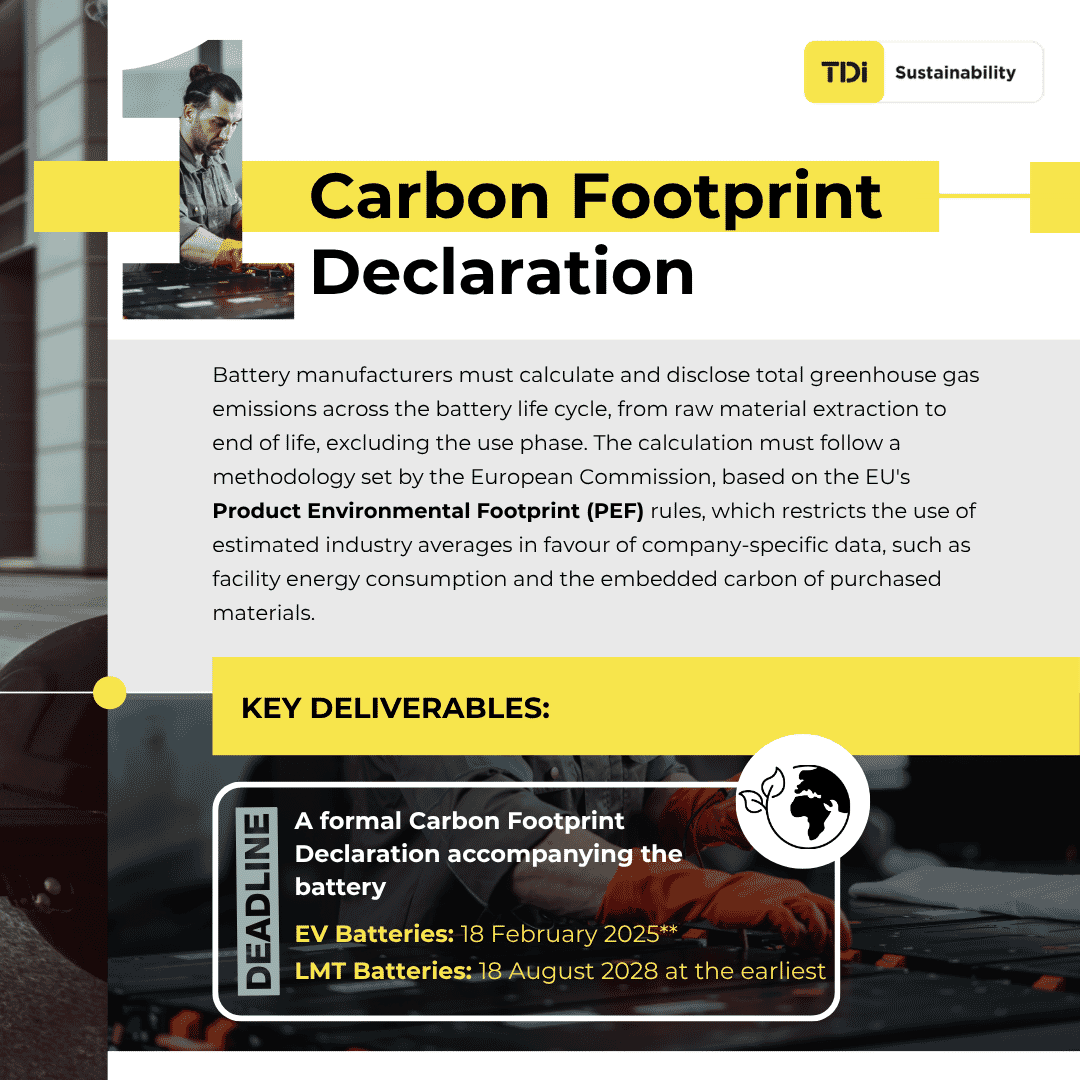
1. Carbon Footprint Declaration
Quantifying the total greenhouse gas emissions for the battery.
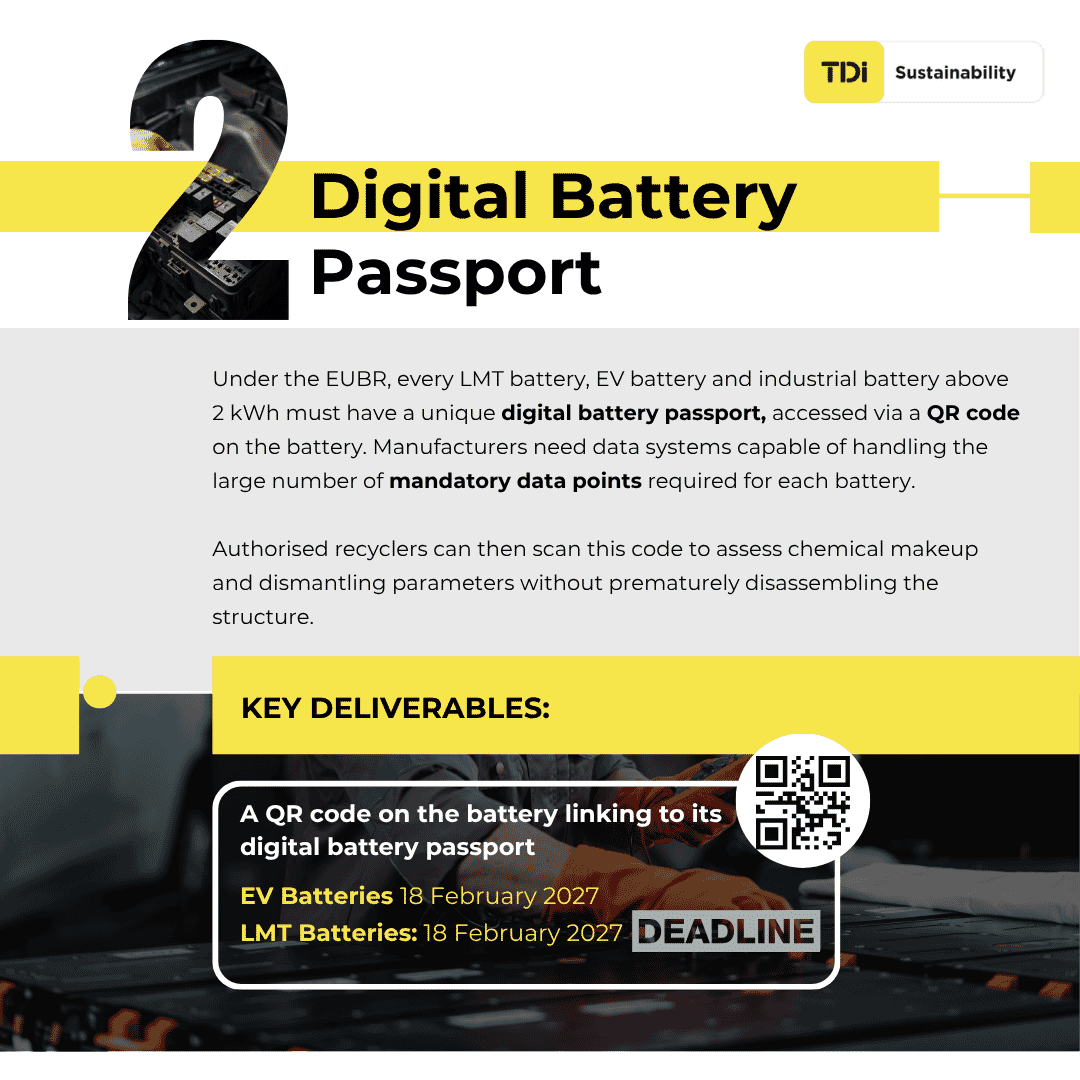
2. Digital Battery Passport
Implementing a QR code-based digital identity.
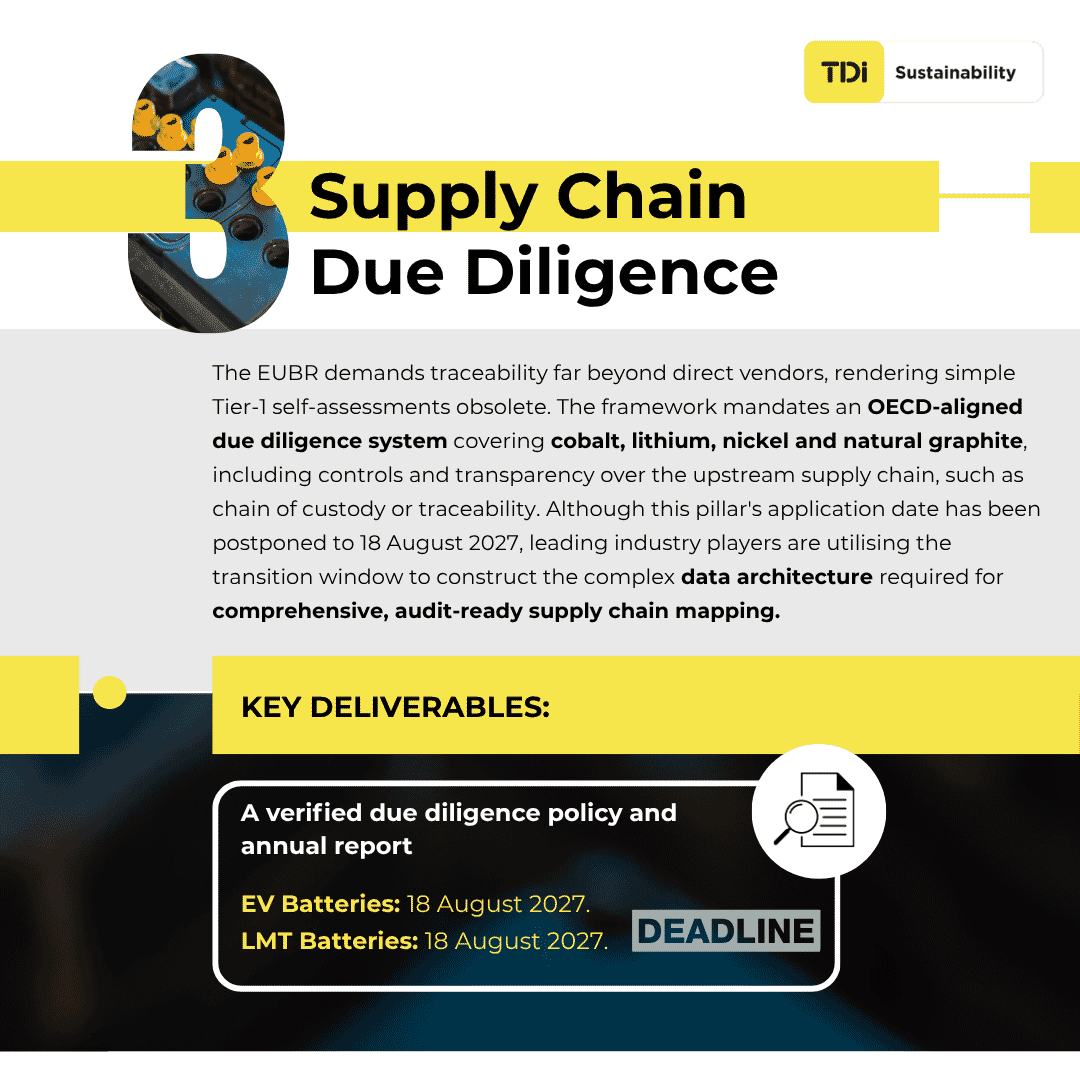
3. Supply chain due diligence
Mapping raw materials (cobalt, lithium, nickel and natural graphite) to ensure ethical sourcing.
4. Performance and durability
Meeting strict technical standards for battery life and health.
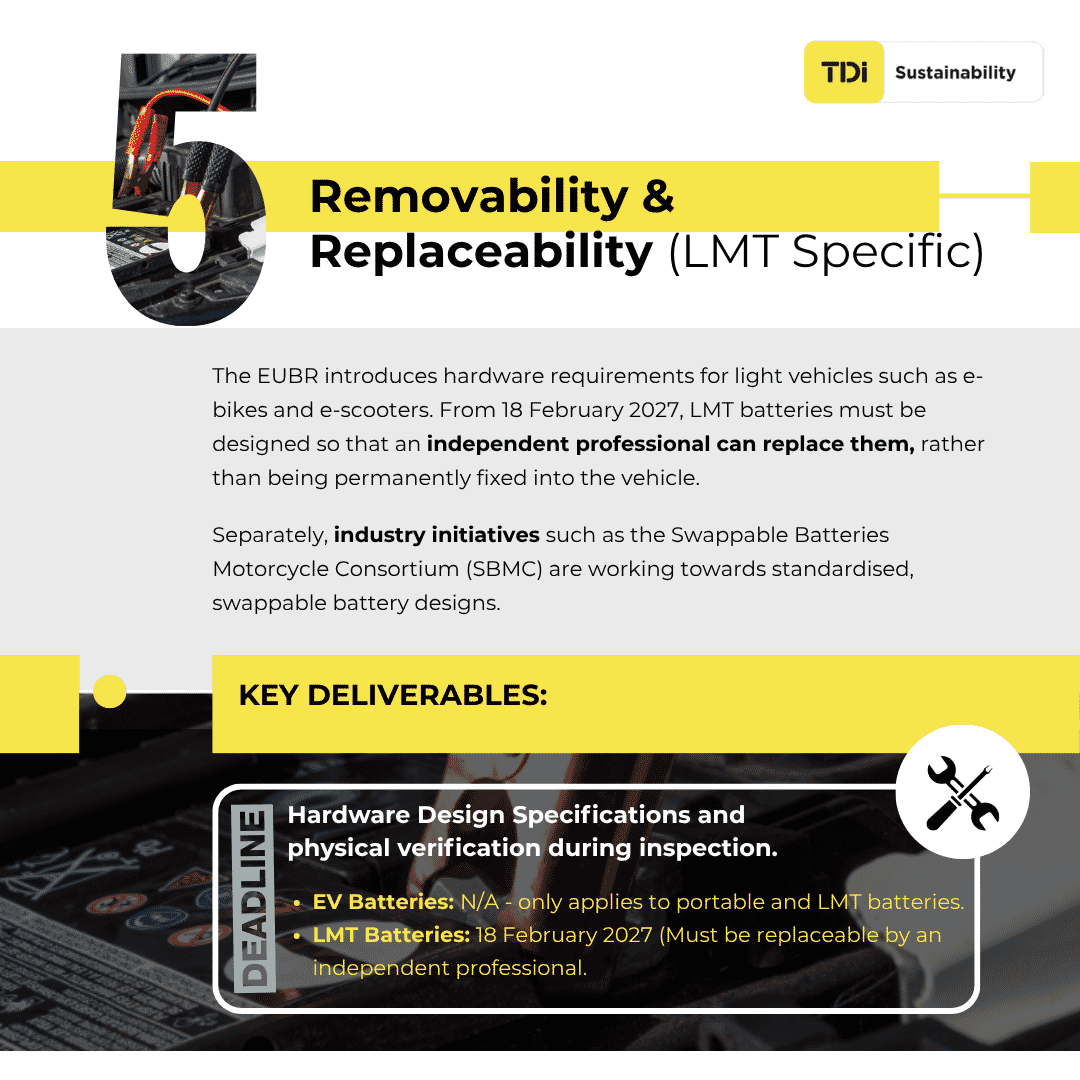
5. Removability and replaceability
Ensuring LMT batteries can be replaced by an independent professional.
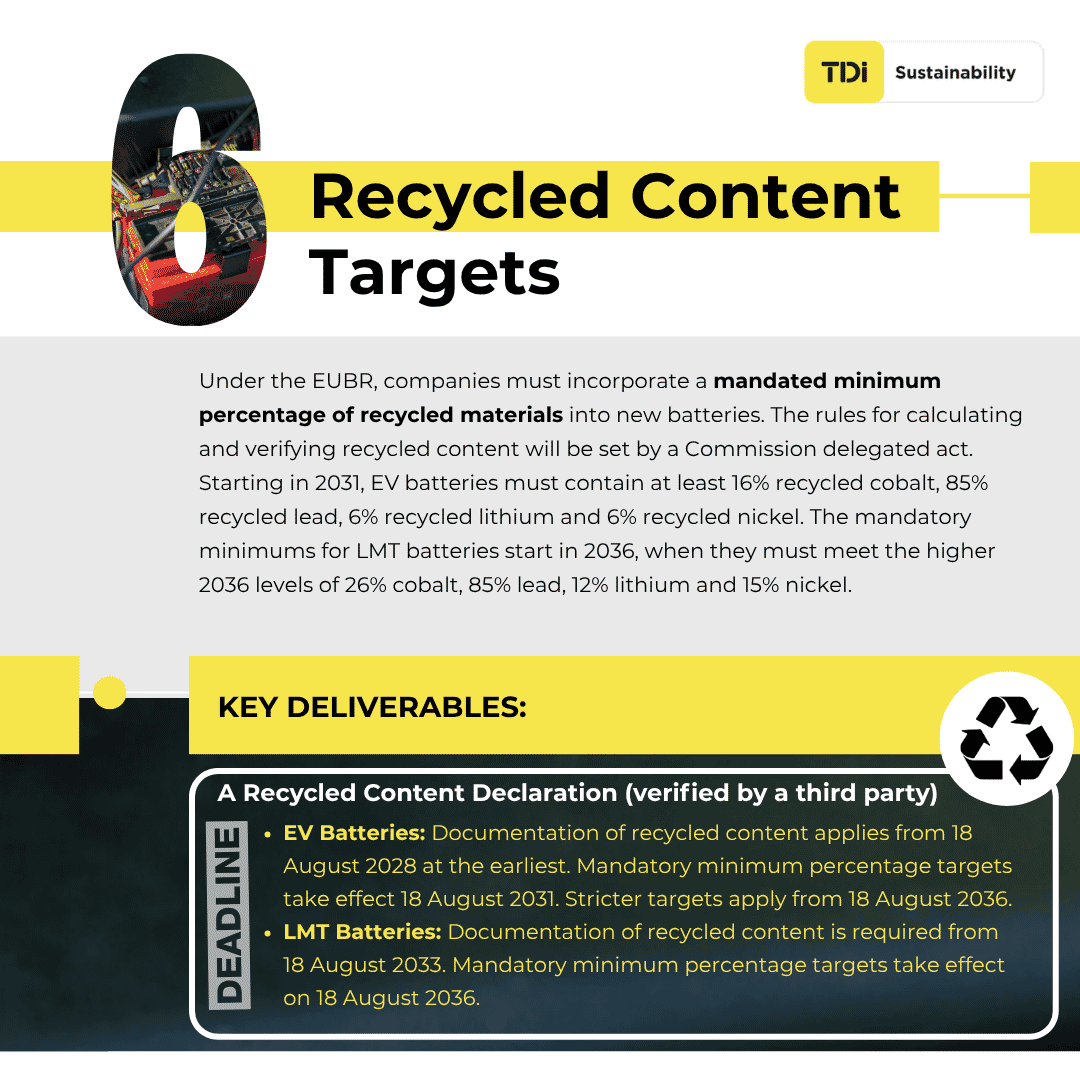
6. Recycled content targets
Meeting minimum percentages of recycled metals in new batteries.
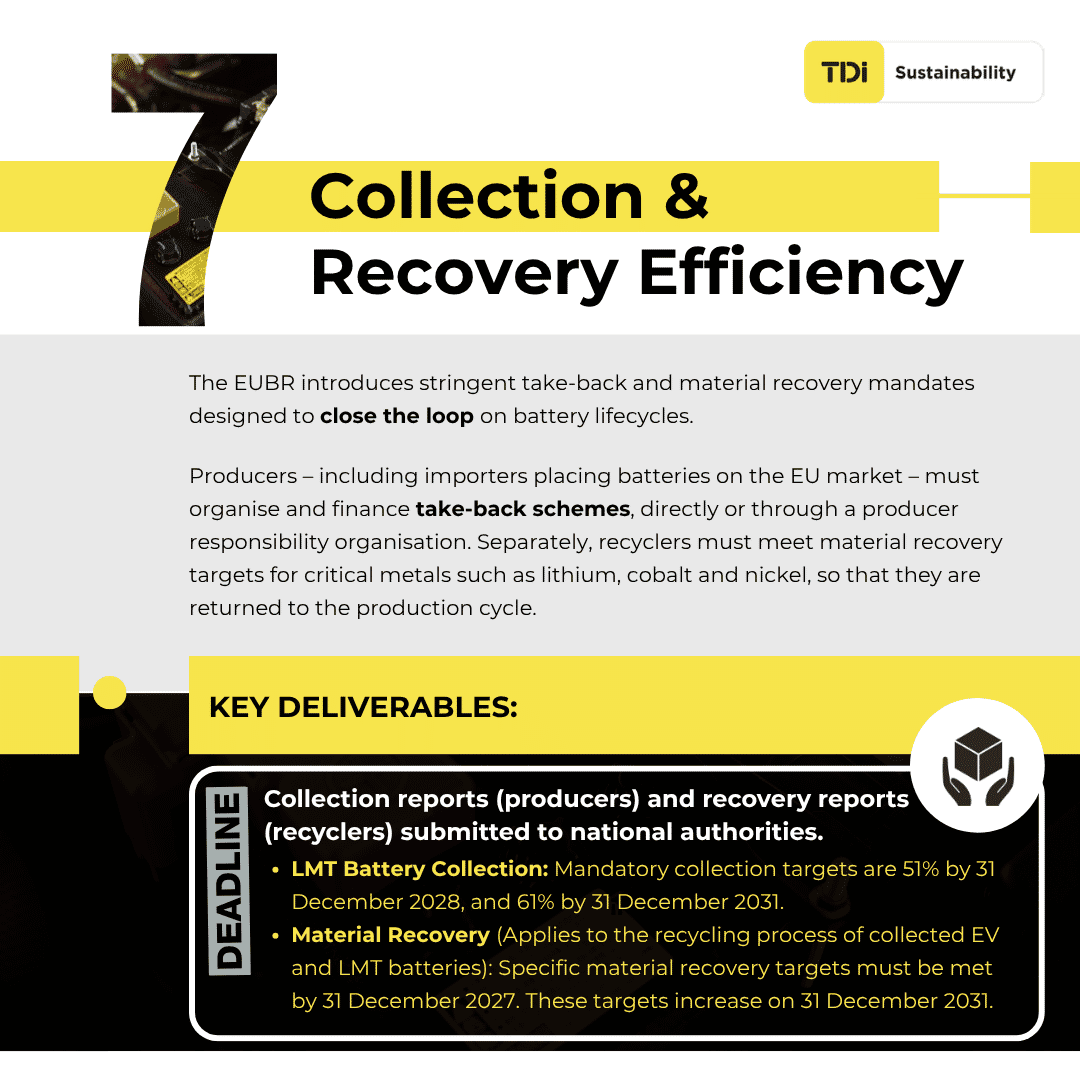
7. Collection and recovery
Ensuring high efficiency in the end-of-life take-back and recycling process.

Deep dive into the 7 pillars of EUBR compliance
To achieve full compliance, original equipment manufacturers (OEMs) must address seven key regulatory demands.
Determining Your Classification: EV vs. LMT
Although these vehicles share two wheels, compliance roadmaps diverge significantly. Specific reporting deadlines and design requirements, such as mandates for battery removability, depend entirely on model configurations and classifications. Electric two-wheelers fall into two primary categories: Electric Vehicles (EVs) and Light Means of Transport (LMTs).
High-Power Electric Vehicles (EVs)
Large, high-performance electric motorcycles, including models from manufacturers like BMW, LiveWire, Zero, and Energica, are typically classified as Electric Vehicles (EVs). Because their traction batteries typically weigh more than 25 kg, they fall into the same EV battery category as electric cars.
Electric vehicle batteries are first in line for several requirements. Carbon footprint declarations were originally scheduled for February 2025, but will now apply 12 months after the European Commission adopts the calculation methodology, which is still pending.
Light Means of Transport (LMTs)
Conversely, smaller and lightweight electric vehicles, including commuter scooters from Segway and Xiaomi, shared fleet scooters from Voi and Lime, e-bikes, and lightweight mopeds, typically use batteries classified as Light Means of Transport (LMT) batteries. These vehicles benefit from an extended transition period, with Carbon Footprint declarations applying from August 2028 at the earliest.
How the EUBR Classifies Two-Wheeler Batteries
Since the EUBR applies different deadlines and design mandates to each battery category, accurate classification is the critical first step. Under Article 3 of the Regulation, the test is set by the battery itself, not by the vehicle’s top speed, market segment or charging method:
• LMT battery: a sealed battery weighing 25 kg or less, designed to power the traction of wheeled vehicles that can be driven by an electric motor alone or by a combination of motor and human power – including type-approved L-category vehicles – and that is not an EV battery.
• EV battery: a battery specifically designed to provide traction power to an L-category vehicle that weighs more than 25 kg, or to provide traction to passenger cars and commercial vehicles.
Removability is not part of the test; it is a consequence of the classification. Once a battery is classified as an LMT battery, it must be replaceable by an independent professional from 18 February 2027.
Grey areas
Borderline cases are most likely where a battery pack sits close to the 25 kg threshold, where a vehicle uses more than one battery pack, or where it is unclear whether a battery counts as sealed. In these cases, a regulatory or legal specialist can help confirm the classification before a compliance roadmap is set.
The Risk of Misclassification
Under the EUBR, battery categories are legal definitions based on the battery’s weight, design and the type of vehicle it powers – not a choice for the manufacturer. Treating an LMT battery as an EV battery, or vice versa, risks applying the wrong requirements and deadlines – for example, missing the February 2027 replaceability requirement that applies only to LMT batteries. Where a product sits in a grey area, a regulatory specialist can help confirm the classification before compliance roadmaps are established.
Your EUBR Roadmap: Understanding the Requirements and Your Category
Classification serves as the initial step, followed by the alignment of hardware, supply chains, and data tracking systems with the EUBR framework.
A consolidated compliance timeline matrix for electric vehicle and light means of transport categories outlines the phased requirements across the core regulatory pillars.
EV vs. LMT Compliance Deadlines & Deliverables
| REGULATORY PILLAR | EV DEADLINE | LMT DEADLINE | DELIVERABLE (verification method) |
| Carbon footprint | February 2025** | August 2028** | Footprint declaration (third-party audit) |
| Battery passport | February 2027 | February 2027 | QR code and cloud registry (technical file) |
| Due diligence | August 2027 | August 2027 | Supply Chain Due Diligence Management System |
| Recycled content | August 2031 | August 2036 | Minimum percentage declaration (third-party certification) |
| Replaceability | N/A | February 2027 | Hardware and design specifications (LMT only) (conformity assessment) |
* Small and medium-sized enterprise (SME) exemption: Economic operators with a net annual turnover below €40 million in the preceding financial year, and that are not part of a group exceeding that threshold on a consolidated basis, are exempt from the EUBR due diligence obligations (policy, third-party verification and reporting). All other requirements – including carbon footprint, battery passport and replaceability – apply regardless of company size, to the battery categories they cover.
**Carbon footprint dates apply from the date shown or 12–18 months after the Commission adopts the calculation methodology, whichever is later. As of September 2026, the methodology has not been adopted.
Omnibus IV: The Small Mid-Cap Expansion
The EUBR due diligence obligations were originally due to apply from 18 August 2025. As part of its Omnibus IV simplification package, the EU postponed them by two years, to 18 August 2027, through Regulation (EU) 2025/1561.
A separate Omnibus IV proposal would go further, raising the due diligence exemption threshold from €40 million to €150 million in annual turnover to cover a newly defined “small mid-cap” (SMC) category. As of [publication month] 2026, this proposal has not been adopted.
Until it is, the €40 million threshold remains the binding legal baseline. Companies near these thresholds should establish their due diligence systems now rather than anticipating unconfirmed legislative exemptions.
Regardless of current EUBR status, due diligence is vital for mitigating sourcing risks, ensuring long-term resilience, and meeting ESG stakeholder expectations around environmental and social impact.
Proactive, voluntary reporting prepares your business for future regulations and can facilitate access to sustainable financing opportunities.
Turn EUBR Compliance into a Supply Chain Advantage
Navigating EUBR mandates, from generating verified carbon footprint declarations to launching digital battery passports, requires a degree of supply chain visibility that most manufacturers are actively developing.
TDi Sustainability bridges that gap, equipping companies with the strategic frameworks and technical tools required to manage complex compliance demands. Operations can be supported across three core pillars:
- Regulatory Tracking: Through the TDi Standards and Regulations Tool, data-driven insights support procurement and legal teams. This tracks how voluntary sustainability standards complement due diligence and reporting requirements for current and upcoming regulations, alongside updates concerning evolving 2026 and 2027 deadlines.
- Digital Traceability: Through the TDi Digital Platform, commodity risk screening and deep-tier supplier mapping identify immediate supply chain vulnerabilities. A comprehensive country and commodity risk assessment tool pinpoints risk origins to guide mitigation procedures.
- Systems Implementation: TDi’s expert team supports organisations in building and operationalising the Due Diligence Management Systems (DDMS) required by third-party auditors. Our team can support you with preparation for upcoming second-party and third-party audits, which includes establishing robust policies and internal verification frameworks. Read our case study on development of DDMS: Supporting a major European small electronics company in conducting digital EUBR due diligence
Get ahead of your compliance timelines.
Schedule a consultation with TDi Sustainability to assess your risk exposure and build your EUBR roadmap.

References
- Regulation (EU) 2023/1542 of the European Parliament and of the Council concerning batteries and waste batteries.
- OECD Due Diligence Guidance for Responsible Supply Chains.
- European Commission Product Environmental Footprint (PEF) guidelines.
- Swappable Batteries Motorcycle Consortium
- Umicore Due Diligence Compliance Report – Cobalt, Lithium and Nickel Procurement – reporting year 2025
- Battery Passport Technical Guidance – March 2024 (reference: 80-100 mandatory data attributes required per battery)